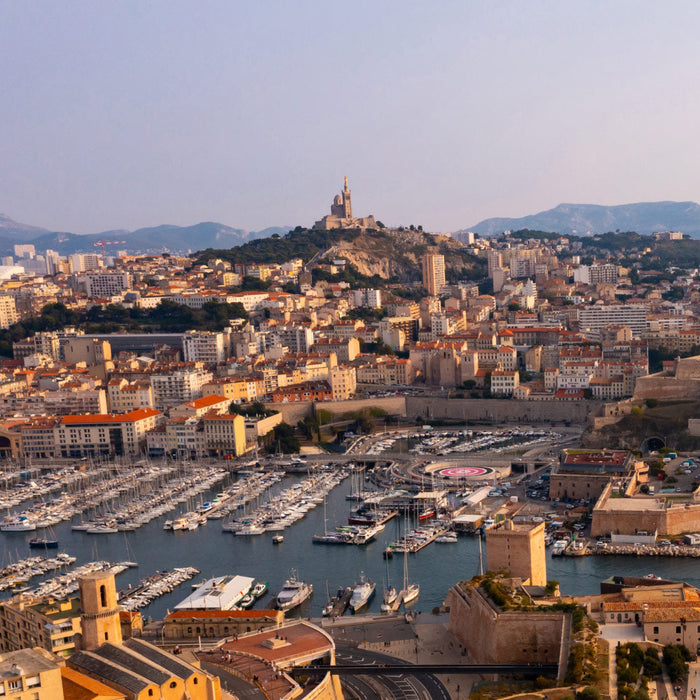
The French port city is shedding its rough reputation and developing into a hub for ambitious cultural and culinary offerings.
No city divides the French quite like Marseille. While some rave about the sun-warmed sea, rugged coastlines, fish-rich bouillabaisse, and Mediterranean melting pot, others complain about corruption and dirty streets. Where supporters see a self-confident, unpretentious metropolis, critics lament a lack of sophistication.
However, there is agreement that Marseille is undergoing a transformation. Extensive urban renewal projects have turned the waterfront into a modern landscape of cultural centers, shopping malls, and skyscrapers. At the same time, innovative seasonal cuisine and independent fashion boutiques are conquering the city, giving it a new coolness and appeal. While some regret that Marseille is losing its distinctive working-class character and Southern French soul, others celebrate the city as more modern, ambitious, and vibrant than ever.
We were inspired by MRSÉY not only in name, but also by its Mediterranean multicultural influences and contrasts. Our tips for an inspiring weekend in Marseille:

Friday
Fort Saint-Jean, built between the 14th and 17th centuries, has been restored and reimagined as a public space. Its bastions, towers, and rooftop gardens offer impressive views of the deep blue sea and the city's panorama, from the postmodern Villa Méditerranée to the 19th-century Neo-Byzantine churches: the Basilica Notre-Dame de la Garde and the Cathédrale Sainte-Marie-Majeure.
A pedestrian bridge connects Fort Saint-Jean with the dramatically cubic museum building of the MuCEM. The sea has shaped Marseille, bringing the Greek and Roman settlers who laid the first stones of ancient Massilia. With the MuCEM, the city has dedicated an impressive museum to this heritage. The rooftop terrace and glass walkways offer spectacular views.

The Panier district, a labyrinth of narrow cobbled streets and small squares, offers culinary classics from the Mediterranean. Start with a thin, crispy pizza (anchovy or cheese) at the lively Chez Etienne, run by Sicilian immigrants since 1943.
Afterward, head to Ripaille next door for dinner. Behind the sky-blue facade, a diverse team cooks modern Mediterranean cuisine: ajo blanco (cold breadcrumb soup) with pickled onions and watermelon cubes, green beans with parsley, jazzed up with crispy breadcrumbs and grated bottarga, Roussillon-style Boles de Picolat (pork meatballs in a tomato, potato, and olive ragout), and for dessert, a nectarine-apricot tart.
Tonight, we're staying in one of the four rooms at La Relève on the other side of the old port. Before that, we'll round off the evening at the bar just around the corner. Gaspard, a tiny, wood-paneled bar, serves specialties like "La Sieste de Shiva" (whiskey, chai spices, and pineapple) – a sweet and sour delight.

Saturday
We'll get our first caffeine fix at Razzia. We can get a croissant right next door at the bakery PAIN PAN! We'll sit with them at the Fontaine du Cours Julien near Notre-Dame du Mont and watch the big city slowly awaken.
On the way back, we'll take the Escaliers du Cours Julien. Not only is the staircase full of constantly changing graffiti, but the adjacent buildings also serve as canvases for street art. If you're here on a weekday, stop by the restaurant Limmat – just like MRSÉY – founded by a Swiss woman who, with her partner, calmly serves not only Swiss and French cuisine but also daily changing Mediterranean mixed dishes.

If you're out and about on the weekend, walk a few steps further back towards the old port. There, right on Place Thiars with its brutalist fountain, is the Bistro Coquille. Here we can choose from the entire palette of the sea: Saint-Jacques Carpaccio, Moules marinières, Merlu rôti (grilled hake) and Sardines Marinées.

After this lunch, we need a short break. We'll treat ourselves under the trees in Parc Pierre Puget, from where we'll begin the ascent to another landmark of Marseille: The path to the Basilisque Notre-Dame de la Garde is worthwhile not only for the sweeping view of the port city from the highest point of the city (149m) or the Neo-Byzantine architecture of the church, but also for what lies beyond:


The small Vauban quarter is the best proof that Marseille's culinary scene has experienced a small renaissance in the last ten years. At Figure, you get the finest "Tapassiettes": Greek tarama in green oil, candied carrots with seaweed jam and mussel pickles, Dauphine potatoes with apricot ketchup and herb mayo, olive sausage in veal jus compote, seasoned with pepper and arrowroot, with spinach sprouts and grilled corn. A taste explosion for the evening before rolling happily and full down the hill back to the harbor.

Sunday
The hallmarks of innovation are unmistakable: rows of vertical pillars that make the concrete building float above the ground, horizontal ribbon windows, and bright primary colors that lighten the gray facade. Massive and modernist – the Cité Radieuse could only have come from the visionary mind of Le Corbusier. The pioneering Swiss architect looked to the future as early as the 1940s and 1950s, when brutalism was still considered avant-garde. Recognized as a UNESCO World Heritage Site since 2016, the building includes several publicly accessible areas, including the rooftop gallery MAMO (open only in summer), a new bookstore, and the 21-room Hotel Le Corbusier.

At noon, we venture a little further out, along the coast to the Tuba Club, which is simultaneously a hotel, restaurant, and beach club. At Bikini, the club's own restaurant with an Aegean terrace, tables in the sun, and a view of the blue sea, we take a break from the hustle and bustle of the big city and treat ourselves to a house-made vanilla or pistachio ice cream after the obligatory portion of clams with white vermouth.

If you're staying another evening, finish it at the restaurant SÉPIA. Chef Paul Langlère, a veteran of some of Alain Ducasse's gastronomic temples, has transformed a disused snack bar into one of Marseille's trendiest restaurants. Located on a green hill, the simple, industrially cool dining room with its outdoor tables offers breathtaking views of the sparkling city. The constantly changing menu focuses on fresh ingredients and creative preparations. During our visit, there was smoked mackerel fillet with a zesty citrus flavor, beetroot spaghetti and diced apple, and horseradish yogurt, followed by a thick fillet mignon with roasted seaweed for a crispy, smoky-salty note.
Our bestsellers for on the go
More articles
READ ALL